Japandi vs modern minimalism — which style suits your apartment?
Japandi blends Japanese calm with Nordic warmth. Modern minimalism favours clean lines and contrast. A practical comparison for apartments in Tricity.
Japandi and modern minimalism often appear side by side on Pinterest, Instagram, and in conversations with clients from Gdańsk, Gdynia, and Sopot. Both aesthetics are calm, orderly, and “chaos-free” — but they create very different everyday impressions. If you are choosing a stylistic direction for your apartment, this article will help you make an informed decision before you start a renovation or commission an interior design project.
What is Japandi?
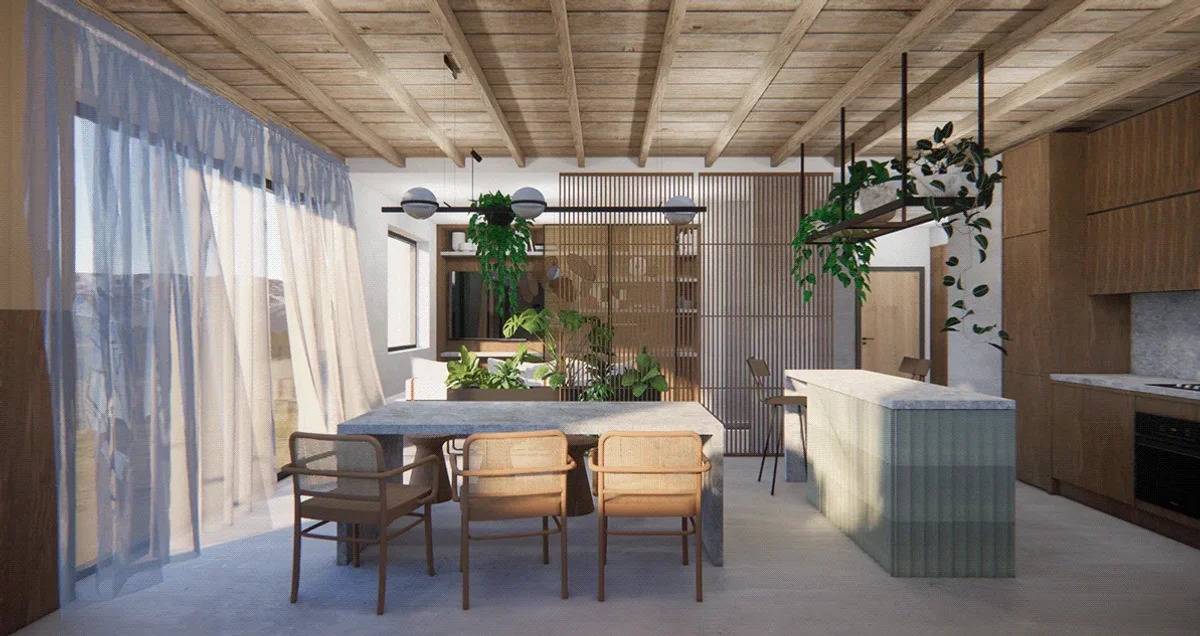
Japandi is a blend of Japanese wabi-sabi philosophy — the beauty of imperfection, simplicity, and closeness to nature — with Scandinavian hygge: warmth, softness, and cosiness. In practice, that means a muted palette, natural materials, low and light furniture, and an interior designed to encourage calm.
In DeMāre Studio projects, Japandi works well in open-plan apartments where the living room, dining area, and kitchen form one daytime zone. See an example in the Japandi conceptual design project — there you can see the style’s typical combination of wood, light walls, and soft textiles.
What is modern minimalism?
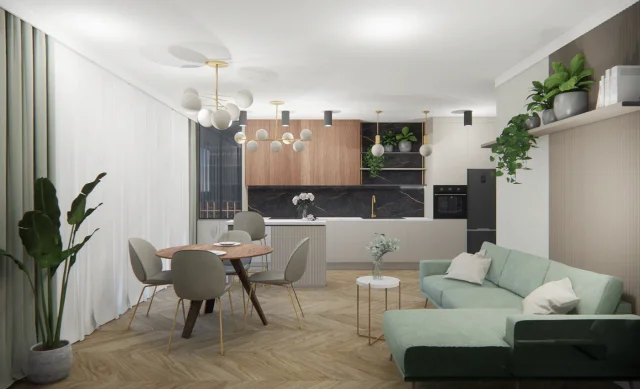
Modern minimalism is an aesthetic built on geometric simplicity, clear lines, contrast, and often a cooler palette. Here, less emphasis falls on handmade character and more on precision of form: smooth fronts, hidden handles, uniform surfaces, sometimes a stronger colour accent or stone with a pronounced texture.
It is a style that looks good in new developer apartments, lofts, and interiors with large glazing — especially in Gdańsk and Gdynia, where many developments have contemporary architecture and open plans.
Japandi vs minimalism — key differences
Colour palette
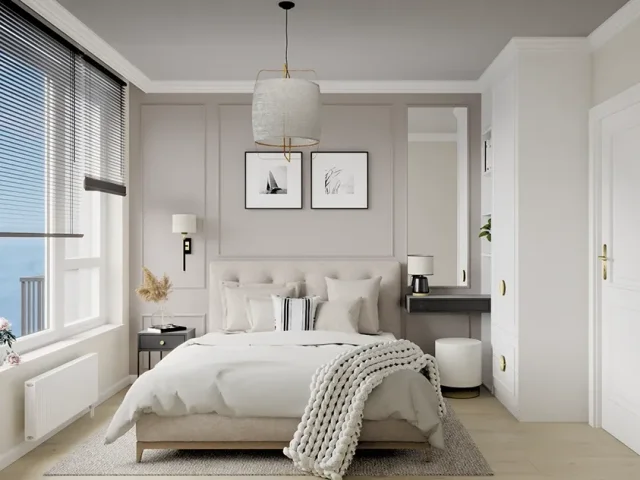
Japandi relies on warm beiges, sand, off-white, light woods, and olive accents. Modern minimalism more often leans toward cooler greys, graphite, pure white, and black details — for example in profiles, lamps, or frames.
Materials
Japandi is dominated by wood, linen, cotton, stone with a matte finish, and textures you can feel by hand. In modern minimalism you more often see lacquered fronts, quartz slabs, glass, metal, and uniform surfaces without visible grain.
Furniture and form
Japandi favours low sofas, simple tables, soft shapes, and furniture at a “human” scale. Minimalism focuses on modularity, sharp edges, bespoke joinery, and a sense of lightness through contrast — for example, dark cabinetry against a light wall.
Lighting and mood
Japandi builds warm, diffused light — table lamps, wall sconces, candles, zone lighting. Minimalism readily uses linear fixtures, recessed spotlights, and stronger architectural effects.
Which style to choose — a practical checklist
Choose Japandi if…
- you want an interior that feels calm, warm, and “homely”;
- you like natural materials and soft textiles;
- you live in an open plan and care about a cosy daytime zone;
- you value a slower pace and an aesthetic close to nature;
- you are furnishing the apartment for yourself, not for mass rental.
Choose modern minimalism if…
- you prefer clean lines, contrast, and a more “hotel-like” effect;
- you have a new developer apartment with large windows;
- you care about easy maintenance and smooth surfaces;
- you like stronger accents — stone, black details, large-format tiles;
- you are designing an investment apartment with emphasis on photogenic appeal and modernity.
What does square footage say?
In studios of 25–40 m², both styles work, but differently. Japandi warms a small space and keeps it from feeling sterile. Minimalism organises square footage through bespoke joinery and hidden storage — a good direction when there is no room for freestanding wardrobes.
In larger apartments of 60–90 m², you can combine both approaches: a calm Japandi base in the relaxation zone and a more graphic minimalism in the kitchen or bathroom. The important thing is not to mix randomly — better to choose a dominant direction and keep materials consistent.
Japandi and minimalism in Tricity — what I see with clients
In Gdańsk and Sopot, I often work with owners of apartments near the centre who want interiors ready for photos and short-term rental — here minimalism is often the safer choice. In Gdynia and in single-family homes, Japandi appears more often: more wood, a calmer palette, less rush.
This is not a rule, but a pointer: the more you care about universality and quick appeal on the rental market, the more often cooler, contrast-driven minimalism works. The more you are furnishing a home for yourself for years to come, the more often Japandi wins.
Common mistakes when choosing a style
- Copying photos without context — a beautiful living room from Instagram does not always suit your square footage and lighting.
- Mixing too many trends — Japandi with marble in a gold frame and loft bricks is usually chaos, not a style.
- Ignoring daylight — in a darker apartment, cool minimalism can look harsh; Japandi carries less sun more easily.
- No storage plan — both styles require hidden wardrobes and thoughtful joinery; otherwise minimalism quickly turns into clutter.
- Buying before layout — a sofa bought “from inspiration” rarely fits the actual functional plan.
What does a project look like at DeMāre Studio?
I do not start with the name of a style — I start with you. At the consultation we establish how you live, what calms you, your budget, and timeline. Only then do I propose a direction: Japandi, modern minimalism, or a calm blend of both.
A typical process includes a functional concept, 3D visualisations, material selection, and — if you need it — an apartment design with documentation for contractors.
Summary
Japandi is warmth, nature, and calm. Modern minimalism is precision, contrast, and contemporary elegance. Both styles are timeless if you keep materials consistent and plan storage from the start.
If you are not sure which direction suits your apartment in Gdańsk, Gdynia, or Sopot, book a free consultation — we will go through square footage, inspiration, and budget, and I will propose a style matched to your way of life, not to fashion.